
In the quiet moments after a tarot spread unfolds before you, the cards whisper truths that can slip away like morning mist if you don’t capture them. Recording your readings through a dedicated tarot journal isn’t just a nice habit—it’s the bridge between fleeting intuition and lasting wisdom. Whether you pull a single daily card or dive into a complex Celtic Cross layout, journaling turns every shuffle into a chapter of your personal story. It sharpens your connection to the deck, reveals hidden patterns in your life, and helps you grow as a reader who trusts their own voice over any guidebook.
Many tarot enthusiasts discover that without a consistent practice of documenting their sessions, insights fade and progress stalls. A well-kept tarot journal becomes your private archive, a living record that shows how the cards have guided you through challenges, celebrations, and everything in between. In this guide, we’ll explore practical, creative, and deeply transformative ways to build and maintain your tarot journal so that every reading feels purposeful and every entry fuels your evolution.
Why Building a Tarot Journal Transforms Your Practice
Think of your tarot journal as a trusted confidant—one that never judges and always remembers. The simple act of writing down your readings creates space for reflection that pure memory can’t match. You begin to notice recurring themes: perhaps the Tower appears whenever major life shifts loom, or the Queen of Cups surfaces during times when emotional boundaries need attention. Over months or years, these patterns become your personal tarot language, more accurate than any generic meaning list.
Journaling also deepens intuition. When you record not just the cards but your immediate gut reactions, physical sensations, and environmental details, you train yourself to listen more closely next time. A reader who journals regularly often reports that interpretations flow faster and feel more authentic because they’ve practiced translating symbols into lived experience.
Beyond intuition, there’s emotional and spiritual growth. Tarot readings can stir powerful feelings—hope, fear, clarity, confusion. Writing them out helps process those emotions safely. One reader I know looked back through two years of entries and realized the Five of Pentacles had appeared during every financial low point, but each time it was followed by the Sun within weeks. That pattern gave her courage during her next rough patch. Your tarot journal becomes proof that the cards don’t just predict—they empower.
Finally, a tarot journal supports accountability. It’s easy to skip readings when life gets busy, but the ritual of opening your journal and dating a fresh page creates gentle discipline. You’ll find yourself reaching for the deck more often, simply because you want to fill another page with insight.
Choosing the Perfect Format for Your Tarot Journal
Your tarot journal should feel like an extension of your practice—comfortable, inspiring, and practical. Some readers prefer a beautiful leather-bound notebook with thick, unlined pages that welcome both writing and sketching. Others opt for a bullet journal system where they can design custom spreads. Digital options, like dedicated apps or password-protected documents, work beautifully if you travel light or want searchable entries.
Consider what you’ll actually use. If you love the tactile feel of pen on paper and enjoy adding washi tape, pressed flowers, or small sketches of cards, a physical journal wins. Choose one with at least 150–200 pages so you won’t run out quickly. Acid-free paper prevents ink bleed, and a hardcover protects your growing archive.
Digital tarot journals shine for organization. You can tag entries by card, mood, or question type, then search years later for every time the Hermit showed up. Many readers combine both: a quick phone note during a reading that gets expanded into a beautiful physical page later. The key is consistency over perfection. Start simple—your system will evolve naturally as you discover what details matter most to you.
Moon phases, astrological transits, and even the weather on reading day can add rich context. Some journals include a small pocket for photos of your physical spreads or crystal companions. Others leave room for oracle card clarifiers. Experiment until your tarot journal feels like a sacred space rather than a chore.

Essential Elements to Include in Every Entry
A strong tarot journal entry captures the moment completely so you can revisit it meaningfully months or years later. Begin with the basics: the date, time, and deck used. Note the moon phase or any significant astrology—perhaps Venus was in retrograde, adding layers to a love reading.
Next, record your question or intention clearly. Vague questions yield vague answers, so phrase it thoughtfully: “What energy should I bring to my new job?” beats “Will work go well?” Write the full spread layout, including card positions and whether any cards were reversed. List each card’s name, suit, and number exactly as it appeared.
Now comes the heart of the entry: your impressions. Start with the very first thought or feeling that arose when you laid the cards out. Did your stomach tighten? Did a color jump out? Did a card remind you of a childhood memory or a song lyric? Capture those raw reactions before you consult any guidebook.
Then move to traditional and personal meanings. Note one or two keywords that feel strongest for each card in this context. Describe the imagery that spoke to you most—perhaps the chained figure in the Devil card looked determined rather than trapped this time. Compare the cards to one another: How does the Page of Swords balance the Ten of Cups in your spread?
End each entry with an action step or takeaway. What one concrete thing will you do differently because of this reading? Even a single sentence like “Schedule that difficult conversation by Friday” turns insight into momentum.
Leave space at the bottom or on the facing page for follow-up notes. Come back in a week or a month and jot what actually happened. This follow-through turns your tarot journal into a powerful feedback loop.
Creative Techniques to Make Journaling Tarot Readings More Engaging
Journaling doesn’t have to mean walls of text. Some of the most insightful tarot journals blend words with visuals and sensory details. Try sketching the cards in your own style—even stick-figure versions capture energy. Color-code your pages: warm tones for fiery insights, cool blues for emotional depth. Add small collages using magazine cutouts that echo the cards’ symbolism.
Sensory journaling adds another dimension. Note the scent of the incense you burned, the playlist that played softly, or the way sunlight fell across the table. These details anchor the reading in your memory and reveal how environment influences interpretation over time.
Try “tarot poetry” entries. Instead of prose, write a short free-verse poem that captures the spread’s essence. Or create a dialogue between two cards in the reading—let the Knight of Wands argue with the Four of Swords about your current energy.
For deeper self-exploration, incorporate prompts that go beyond the reading itself. Ask: “How does this card mirror a part of me I’ve been ignoring?” or “If this spread were a movie scene, what would the soundtrack sound like?” Keep a running list of evolving personal keywords for each card. Your understanding of the Three of Swords might shift from “heartbreak” to “necessary release” after several journaled readings.
Many readers add a gratitude section at the close of every entry. Even challenging readings contain gifts—acknowledge them. Some maintain a separate “Tarot Time Capsule” section where they seal a prediction or intention in an envelope to open six months later. The joy of rediscovering how accurate (or delightfully off) your earlier self was never gets old.

Monthly and Quarterly Reviews: Turning Data into Wisdom
Your tarot journal truly shines when you step back and analyze it holistically. Set aside time at the end of each month to review entries. Which cards appeared most frequently? What questions dominated your sessions? Did certain suits show up during specific life areas—pentacles during work stress, cups during relationship shifts?
Create simple charts or mind maps. Colorful bar graphs of suit frequency or a word cloud of recurring themes can reveal surprising patterns. One long-time reader discovered she pulled the Chariot every time she faced a major decision but only when she was secretly resisting forward movement. That single insight changed how she approached future crossroads.
Quarterly reviews go deeper. Compare seasons: Did winter readings carry heavier Major Arcana energy while summer brought more joyful minors? Look for growth arcs. Notice how early entries full of confusion gradually give way to confident, nuanced interpretations. Celebrate that evolution—it’s tangible proof of your development as a reader.
These reviews also prevent “tarot burnout.” When you see how far you’ve come, the practice feels rewarding rather than repetitive.
Avoiding Common Pitfalls That Stall Progress
Even dedicated readers sometimes fall into habits that limit their tarot journal’s power. One of the biggest is perfectionism—waiting for the “right” journal or the perfect pen. Start messy. Your first entries might look chaotic, but they’re still valuable.
Another trap is over-relying on book meanings. Your journal should be at least 70% your own voice. Guidebooks are training wheels; eventually your personal insights should steer.
Resist the urge to edit while writing. Record everything, even if it feels silly or contradictory. Clarity often emerges later. Also, don’t skip difficult readings. The spreads that confuse or upset you frequently contain the richest lessons once processed on paper.
Finally, avoid comparing your journal to anyone else’s. Instagram-worthy spreads with perfect calligraphy are lovely, but your messy, heartfelt pages hold more magic because they’re authentically yours.
Sample Journal Entry and Template You Can Adapt
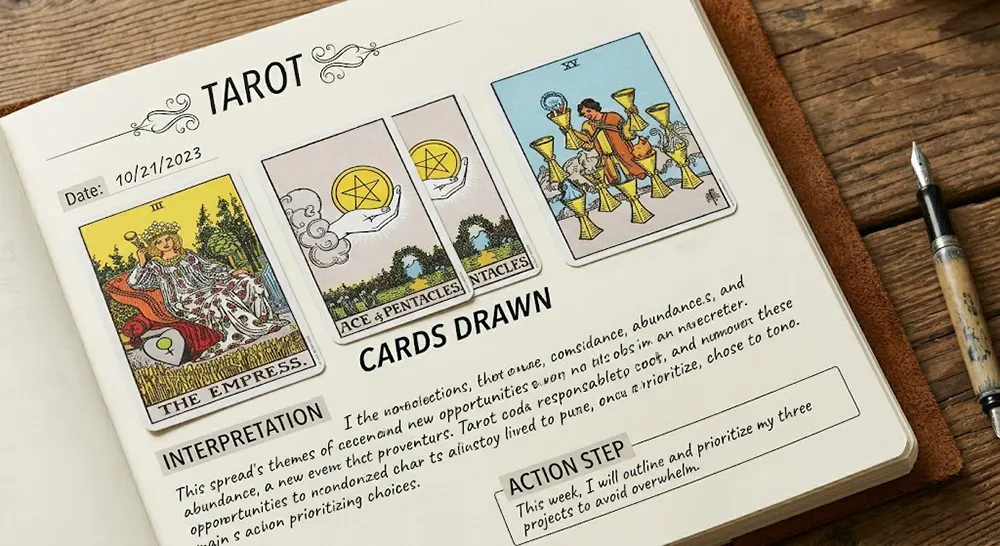
Here’s a simple yet powerful template you can copy into your own journal:
Date: [Month Day, Year] Deck: [Name] Moon Phase/Astrology: [Details] Question/Intention: [Exact wording] Spread: [Name and positions]
Cards Drawn:
- Position – Card (reversed?) – Initial gut reaction:
- Position – Card (reversed?) – Initial gut reaction:
Detailed Interpretation: [Free writing] Personal Keywords: [List] Action Step: [One clear next move] Follow-Up Date: [When you’ll check back]
Feel free to expand or simplify. Some readers add a “vibe rating” from 1–10 or a quick emoji summary.
15 Powerful Prompts to Spark Deeper Tarot Journal Entries
- What surprised me most about this spread, and why?
- Which card feels like a mirror to my current emotional state?
- If this reading were advice from my future self, what would it say?
- How do the colors and symbols in these cards connect to my real life right now?
- What fear is this spread gently inviting me to face?
- Which card would I gift to a friend in my situation, and why?
- How has my understanding of [specific card] changed since I last pulled it?
- What sensory memory or song lyric does this spread evoke?
- If these cards formed a story, what would the title be?
- What small daily habit would honor the energy of this reading?
- Where do I feel resistance in this spread, and what might that teach me?
- How do the reversed cards (if any) flip my usual perspective?
- What part of myself is celebrating this reading?
- Looking back at the last three entries, what pattern emerges?
- What am I most grateful for learning through these cards today?
Use one or more whenever you need a fresh angle.
Frequently Asked Questions About Tarot Journaling
How often should I journal my readings? Daily or every other day works beautifully for building intuition. Even one card a day compounds into profound growth over time. Quality matters more than quantity—better one thoughtful entry than seven rushed ones.
What if I don’t understand a card right away? Write your confusion honestly. Note what you do feel, even if it’s “this feels blocked” or “I have no idea.” Return later or sleep on it. Clarity almost always arrives when you stop forcing it.
Should I include reversals in my journal? Absolutely. Record them and explore whether they indicate blocked energy, internal lessons, or simply a different flavor of the upright meaning. Your evolving relationship with reversals will become one of your greatest strengths.
Can I use the same journal for tarot and other practices like shadow work or astrology? Many readers combine them successfully. Just create clear sections or use tabs so you can find tarot entries quickly. The cross-pollination often leads to richer insights.
Is it okay to journal for other people? Yes, with permission. Note that it was a reading for someone else and respect their privacy. These entries can still teach you volumes about your reading style.
What if I miss several days or weeks? Pick up exactly where you are. No guilt. Write a short “catch-up” entry acknowledging the gap and any major life events that occurred. Your journal will forgive you.
Should beginners use pre-made templates or create their own? Start with a simple template to build confidence, then customize wildly. Your ideal system will reveal itself through trial and error.
Your Tarot Journal Awaits: A Final Invitation
Every great tarot reader you admire almost certainly keeps some form of record. Your journal is more than paper and ink—it’s the living map of your soul’s conversation with the cards. It holds your doubts, your breakthroughs, your quiet victories, and the gentle guidance that has carried you forward.
Start today. Open a fresh page, light a candle if you like, shuffle your deck with intention, and let the first entry flow. The cards have been waiting to speak to you in this deeper, more personal way. Over time you’ll look back and see not just scattered readings but a beautiful tapestry of growth, resilience, and magic.
Your future self will thank you for every word you write today. The wisdom is already within the cards—and now it can live forever within the pages of your own unique tarot journal.
Begin. Reflect. Record. And watch your tarot practice transform into something truly extraordinary.
Related Posts
Love Tarot Reading: What to Expect in Your Journey to Romance and Connection
Using Intuition vs. Book Meanings in Tarot Readings: The Ultimate Guide to Intuitive Mastery
Tarot Reading Ethics: A Comprehensive Guide to Ethical Practices When Reading for Others
Dealing with Negative Tarot Cards: Essential Tips for Handling Difficult Cards During a Reading
How to Interpret Tarot Spread Positions: A Beginner’s Guide to Unlocking Insights in Tarot Reading
How to Cleanse Tarot Deck: 10 Essential Methods and Rituals