
In the world of tarot, few topics spark as much passionate discussion as the balance between intuition in tarot readings and traditional book meanings. New readers often feel torn: Should you memorize the “official” interpretations from guidebooks, or trust that quiet inner voice whispering something entirely different? This debate isn’t just academic—it shapes every reading you give and every insight you receive.
As someone who has spent years guiding beginners and advanced readers alike, I’ve seen firsthand how mastering this balance transforms flat, robotic readings into deeply personal, accurate, and transformative experiences. This comprehensive guide cuts through the noise. You’ll discover why neither pure memorization nor “anything goes” intuition works best on its own, how to blend both for powerful results, practical exercises you can start today, real-world case studies, and expert tips optimized for real growth.
Whether you’re a complete beginner or an experienced reader seeking deeper connection, this article delivers actionable value. By the end, you’ll have a clear framework—the “Intuitive Traditionalist Matrix”—to develop rock-solid confidence in your intuition in tarot readings while honoring the rich tradition of book meanings tarot. Let’s dive in.
What Are Book Meanings in Tarot? The Foundation Every Reader Needs
Book meanings form the bedrock of tarot study. These standardized interpretations—often drawn from the Rider-Waite-Smith tradition, Golden Dawn symbolism, numerology, astrology, and elemental correspondences—provide consistent language for the 78 cards.
For example, the upright Three of Swords traditionally signals heartbreak, betrayal, or painful truth. The reversed Ace of Wands suggests delayed creative energy or blocked passion. These keywords and stories give beginners a reliable starting point, preventing total guesswork and building a shared vocabulary across readers worldwide.
Benefits of relying on book meanings tarot:
- Structure and consistency — Ideal for beginners who need scaffolding.
- Historical depth — Connects you to centuries of esoteric wisdom.
- Clarity in complex spreads — Helps when emotions run high or intuition feels quiet.
However, over-reliance creates problems. Readings become mechanical, like reciting flashcards instead of having a conversation with the cards. Clients sense the disconnect, and your own growth stalls because you’re not engaging the subconscious mind where true magic happens.
The Power of Intuition in Tarot Readings: Your Inner Compass
Intuition isn’t woo-woo mysticism—it’s your brain’s rapid pattern-recognition system working faster than conscious thought. In intuition in tarot readings, this shows up as sudden flashes, emotional pulls, visual details that “pop,” or even physical sensations when a card appears.
Think of book meanings as the GPS map and intuition as real-time traffic updates, detours, and hidden shortcuts. The map gets you in the general area; intuition navigates the actual journey with precision tailored to the moment.
Unique insight: Intuition often reveals why a traditional meaning applies (or doesn’t). The Three of Swords might mean heartbreak per the book—but your intuition could flash an image of a specific past argument, pointing to unresolved forgiveness rather than new pain. That personalized layer turns generic advice into life-changing guidance.
Modern psychology supports this. Studies on “thin-slicing” (Malcolm Gladwell’s Blink) show experts make accurate snap judgments after years of deliberate practice. Tarot intuition works the same way: the more you study book meanings, the sharper your intuitive hits become.
The Great Debate: Intuition vs. Book Meanings Tarot – Why Both Matter
The “intuitive-only” camp argues that tarot is a mirror for the subconscious; rigid meanings block authentic messages. The “traditionalist” side warns that pure intuition without grounding leads to projection and inaccuracy.
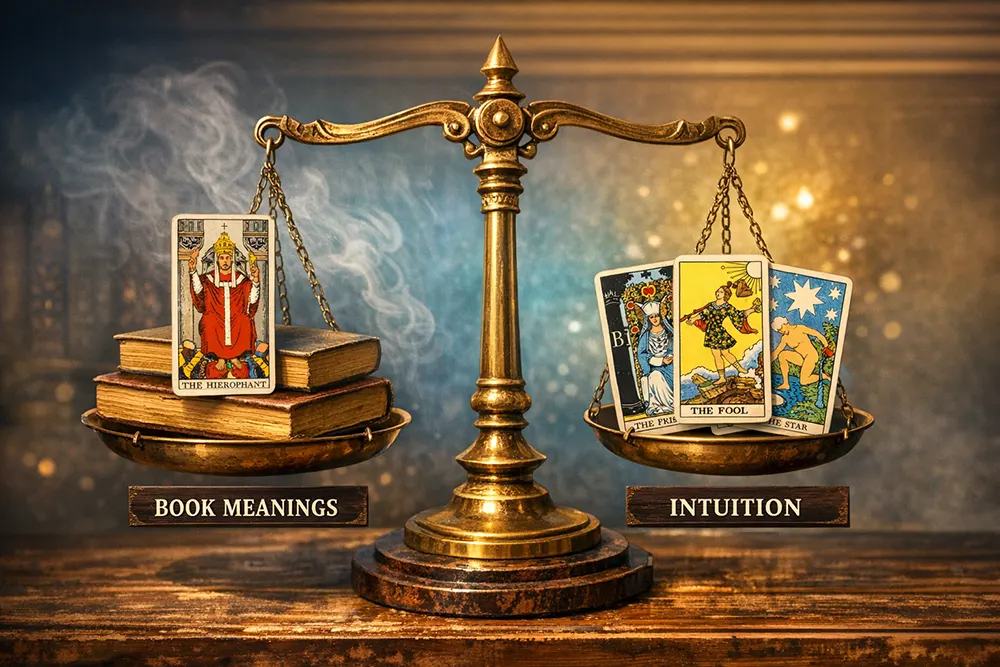
Reality? The strongest readers are Intuitive Traditionalists. They master book meanings first, then layer personal intuition on top.
| Aspect | Book Meanings Only | Pure Intuition Only | Balanced Intuitive Traditionalist |
|---|---|---|---|
| Accuracy for Beginners | High (structured) | Low (risk of projection) | Highest (foundation + personalization) |
| Emotional Depth | Medium | High | Deepest |
| Consistency | Very High | Variable | High with flexibility |
| Client Connection | Can feel robotic | Highly personal | Transformative & relatable |
The Intuitive Traditionalist Matrix: A Unique Framework for Mastery
Here’s an original system I’ve refined over thousands of readings—the Intuitive Traditionalist Matrix. It has three layers you activate in every reading:
- Layer 1: Anchor (Book Meanings) – Note the traditional upright/reversed keywords and core symbolism in under 10 seconds.
- Layer 2: Ignite (Intuitive Flash) – Close your eyes, breathe, and ask: “What else is this card showing me right now?” Capture the first image, emotion, memory, or word.
- Layer 3: Weave (Synthesis) – Merge both. Ask: “How does my intuitive hit refine or expand the traditional meaning for this exact question and person?”
This matrix prevents both extremes: no more boring recitations or wildly off-base guesses. It creates readings that feel magically accurate.
Pro tip for developing intuition for tarot: Keep a “Personal Keyword Journal.” For each card, write 3 traditional keywords + 3 intuitive ones that arise during practice. Over time, your deck becomes a living conversation partner.
Practical Exercises to Strengthen Intuition in Tarot Readings
Ready to practice? These beginner-friendly exercises build intuition muscle fast:
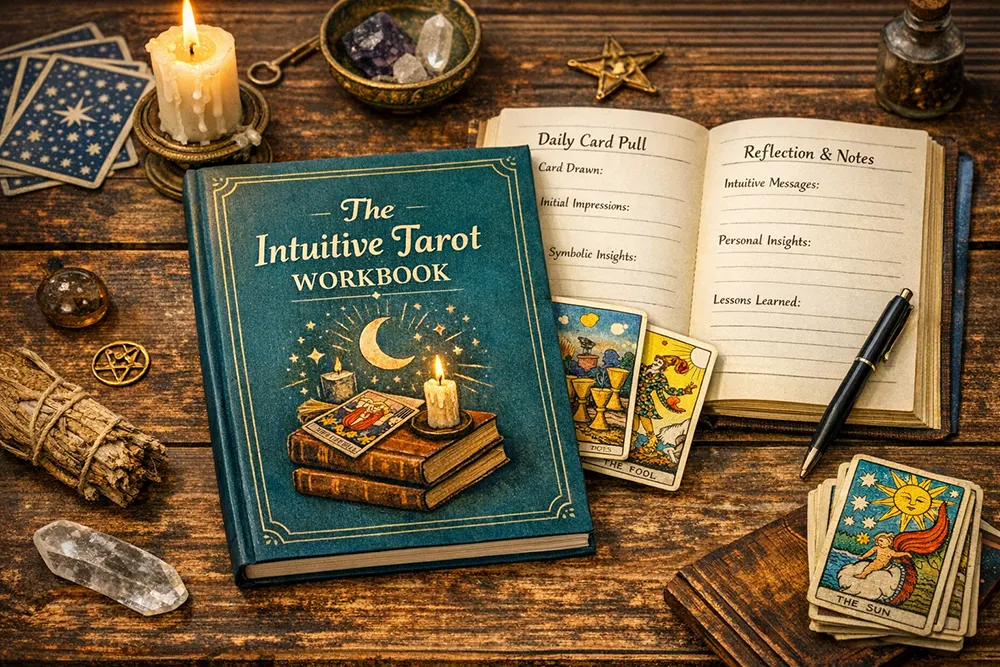
Exercise 1: One-Card Intuitive Scan (5 minutes daily) Shuffle, draw one card face-up. Spend 60 seconds noting book meaning, then close your eyes and describe everything your intuition notices (colors that stand out, feelings in your body, random memories). Journal both.
Exercise 2: Blind Intuition Pull Draw a card without looking at the image first. Feel its energy, then flip it and compare. This trains you to trust before visual cues.
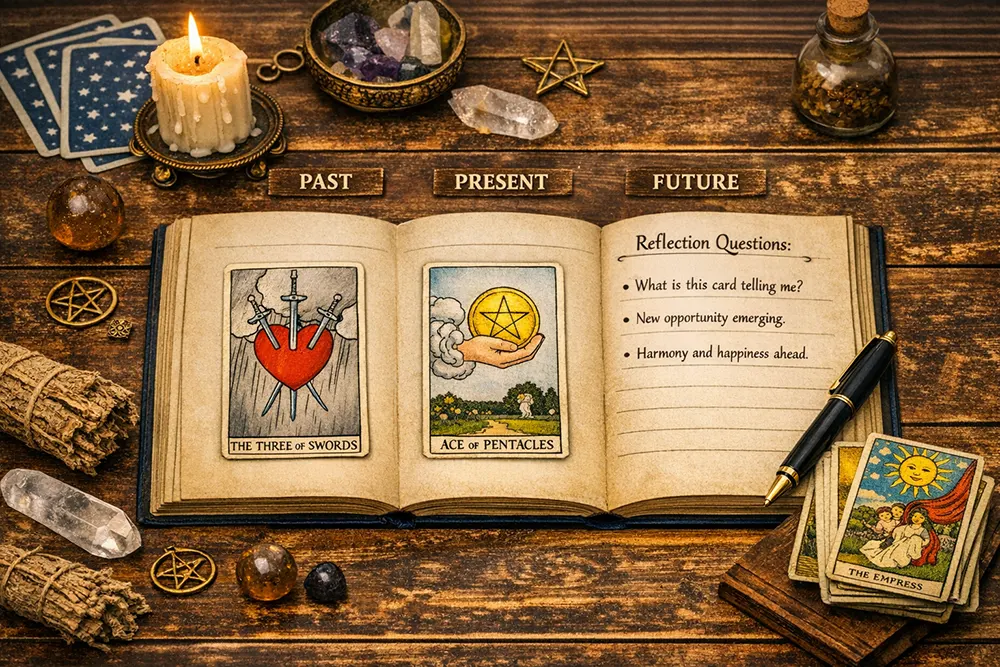
Exercise 3: Story Weaving Pull three cards. Tell the “book version” story first. Then retell it using only intuitive flashes. Notice how the second version feels more alive.
Exercise 4: Client Simulation Ask a friend a real question. Do the reading using the Matrix above. Record it and follow up later for feedback.
Common Mistakes Beginners Make (and Easy Fixes)
- Mistake 1: Ignoring intuition because “the book says otherwise.” Fix: Always check in with Layer 2 before finalizing.
- Mistake 2: Overthinking the intuitive hit. Fix: Trust the first impression—intuition speaks quietly and quickly.
- Mistake 3: Skipping book study. Fix: Spend 20 minutes daily on one card’s traditional meanings before intuitive practice.
Real-Life Reading Examples: Intuition in Action
Case Study 1: Career Question Book meaning for the Tower: sudden upheaval. Intuitive flash: client’s face lit up with excitement instead of fear. Synthesis: “This ‘disruption’ is actually the breakthrough you’ve been praying for—your soul’s way of forcing you into the dream job.” Client confirmed a surprise promotion offer the next day.
Case Study 2: Relationship Reading Traditional Lovers card: harmony and choice. Intuition showed a locked door in the background imagery. Synthesis revealed the choice wasn’t between two partners but between staying in a comfortable but growth-stifling relationship or choosing self-love. The client later ended a long-term but unfulfilling partnership with relief.
These examples prove that intuition in tarot readings doesn’t replace book meanings—it supercharges them.
Frequently Asked Questions (FAQs) About Intuition in Tarot Readings
Q1: Do I need to memorize all 78 book meanings before using intuition? No. Learn the Major Arcana and core suits first, then layer intuition immediately. The Matrix works at any level.
Q2: What if my intuition contradicts the book? Trust the synthesis. Your intuition is adapting the ancient wisdom to the present moment and specific querent.
Q3: How do I know it’s intuition and not wishful thinking? True intuition feels neutral or surprising, not emotionally charged by your desires. Journaling and client feedback help calibrate.
Q4: Can digital tarot apps support intuition in tarot readings? Absolutely. The cards are tools; intuition is the reader. Use apps for daily practice to sharpen both aspects.
Q5: How long until I feel confident blending both? Most readers notice major improvement in 30 days with daily 10-minute practice.
Conclusion: Become the Reader the Cards Deserve
Mastering intuition in tarot readings while respecting book meanings tarot isn’t about choosing sides—it’s about becoming a bridge between ancient wisdom and modern insight. When you honor both, your readings stop being predictions and start becoming empowering conversations that change lives.
The cards have always been waiting for you—your unique perspective, your lived experiences, your authentic voice. Start small today: pull one card, apply the Intuitive Traditionalist Matrix, and watch your practice transform.
Your intuition is already wise. The book meanings simply give it language. Together, they create magic no single approach could achieve alone.
Ready to deepen your practice? Grab your deck, open your journal, and begin. The tarot community needs more Intuitive Traditionalists—confident, compassionate, and powerfully accurate.
Share this guide with fellow readers who are still stuck in the debate. The more we embrace both intuition and tradition, the stronger our collective craft becomes.
Related Posts
Love Tarot Reading: What to Expect in Your Journey to Romance and Connection
Recording Your Readings: Journaling Tips
Tarot Reading Ethics: A Comprehensive Guide to Ethical Practices When Reading for Others
Dealing with Negative Tarot Cards: Essential Tips for Handling Difficult Cards During a Reading
How to Interpret Tarot Spread Positions: A Beginner’s Guide to Unlocking Insights in Tarot Reading
How to Cleanse Tarot Deck: 10 Essential Methods and Rituals