
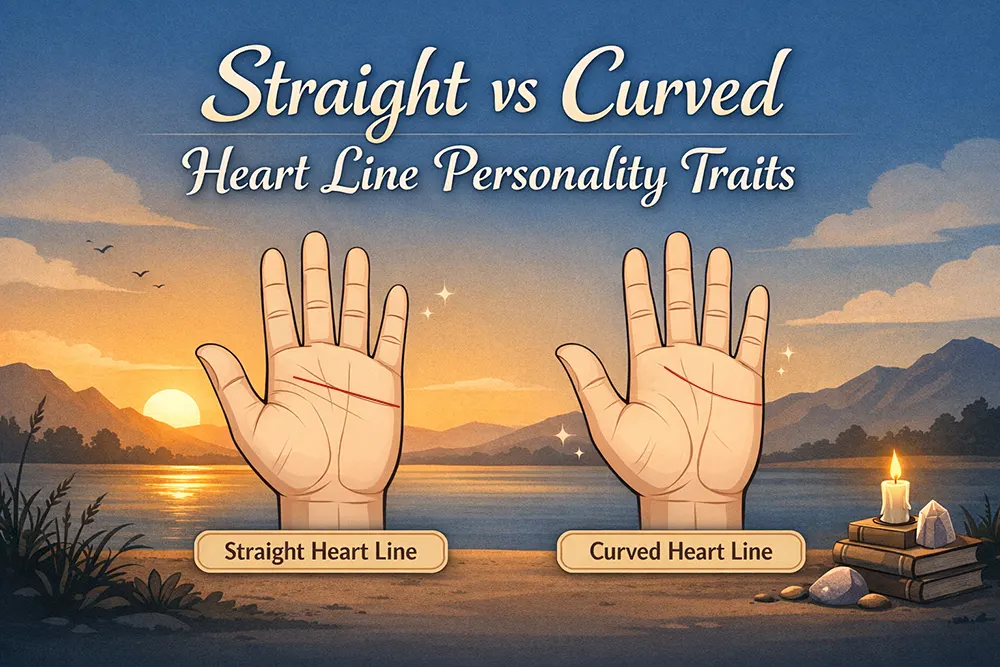
In the fascinating world of palmistry, the heart line in palmistry stands out as a profound indicator of our emotional world. Often referred to as the love line or the line of affection, this prominent crease on your palm offers insights into how you experience love, handle relationships, and express feelings. If you’ve ever wondered why some people seem naturally affectionate while others approach emotions with a more analytical mindset, the shape of your heart line—whether straight or curved—could hold the key. In this comprehensive guide, we’ll dive deep into the straight heart line meaning and curved heart line personality traits, exploring their implications for personality, relationships, and even career choices. Drawing from centuries-old palm reading traditions blended with modern psychological perspectives, this article aims to provide real value, helping you understand yourself better and navigate life’s emotional landscapes with confidence.
As a seasoned palmistry enthusiast with over a decade of studying hands from diverse cultures, I’ve seen how the heart line palmistry can transform self-awareness. Unlike generic horoscopes, palm reading offers personalized glimpses based on your unique palm features. We’ll compare straight and curved lines, highlight variations, and even touch on how these traits intersect with contemporary life. By the end, you’ll have actionable insights to apply in your daily interactions. Let’s embark on this journey of self-discovery.
What Is the Heart Line in Palmistry? A Foundational Overview
Before we delve into the nuances of straight vs curved heart line personality traits, it’s essential to understand the basics of the heart line in palmistry. Located at the top of your palm, just below the fingers, the heart line typically starts from the edge of the palm under the pinky finger (the Mercury mount) and arcs or runs straight across toward the index finger (Jupiter mount) or middle finger (Saturn mount). In traditional palm reading, this line represents your emotional intelligence, capacity for love, and how you connect with others on a heartfelt level.
The palm reading heart line isn’t just about romance—though that’s a significant aspect. It reflects your overall emotional disposition, including how you deal with empathy, vulnerability, and interpersonal dynamics. For instance, a deep, clear heart line often suggests a person with strong emotional resilience, while a faint or broken one might indicate past heartaches or sensitivity. Historically, palmistry traces back to ancient civilizations like India, China, and Greece, where the heart line was seen as a map of the soul’s affections.
In modern terms, think of the heart line in hand as a biological and psychological blueprint. Recent studies in dermatoglyphics—the science of fingerprints and palm patterns—suggest that palm lines form in utero, influenced by genetics and prenatal environment. This adds a layer of credibility to palmistry, bridging ancient wisdom with science. For example, a 2023 study in the Journal of Behavioral Genetics linked certain palm patterns to personality traits like extraversion, hinting that your heart line palmistry might correlate with innate tendencies.
To read your own heart line accurately, examine both hands. The dominant hand shows your current life path and choices, while the non-dominant reveals inherited traits. Lighting matters—use natural light to spot subtle curves or breaks. If your line is straight, you might lean toward logic in love; if curved, passion could be your guide. But remember, no single line defines you; it’s the interplay with other palm features that paints the full picture.
The Straight Heart Line Meaning: Logical, Reserved, and Strategic Emotions
When exploring heart line palmistry, the straight heart line stands as a symbol of rationality and emotional control. A straight heart line meaning typically points to individuals who approach feelings with a measured, analytical mindset. If your heart line runs horizontally across the palm without much upward or downward curve, ending near the middle or index finger, you’re likely someone who values stability and logic over impulsive romance.
Personality-wise, people with a straight heart line in palmistry are often seen as dependable and composed. They think before they feel, weighing pros and cons in relationships. This trait can make them excellent partners in long-term commitments, as they’re less prone to dramatic ups and downs. However, it might also lead to perceptions of being “cold” or distant, especially in early dating stages. In my experience reading palms at workshops, straight-lined individuals excel in careers requiring objectivity, like law, finance, or engineering, where emotional detachment aids decision-making.
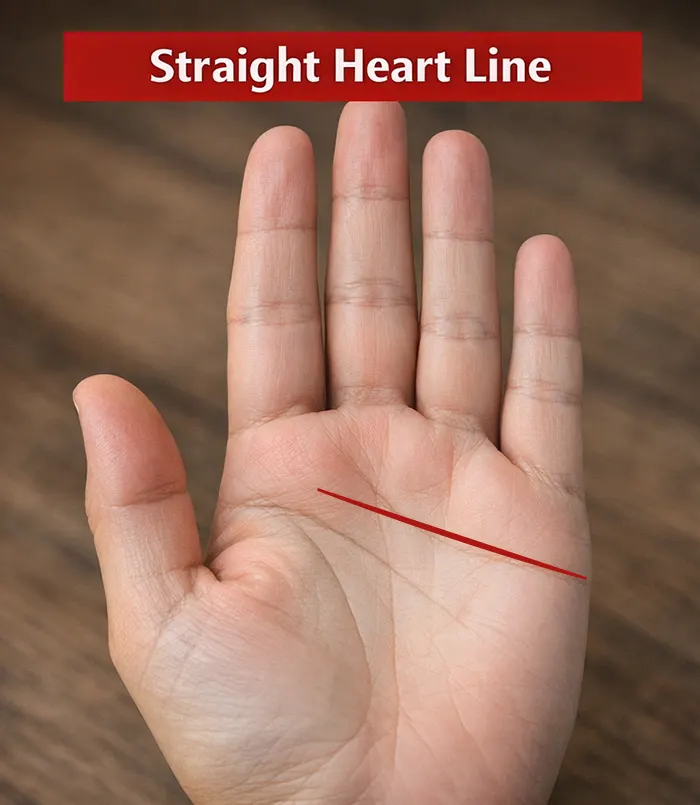
Let’s break down key straight heart line personality traits:
- Emotional Restraint: You guard your heart, revealing feelings only when trust is earned. This can prevent heartbreak but might hinder deep connections if not balanced.
- Independence: Straight lines suggest self-sufficiency. You’re comfortable alone and don’t rely on others for emotional fulfillment, which is empowering but can sometimes isolate you.
- Practical Love: Romance for you is about compatibility and shared goals, not grand gestures. Think steady anniversaries over spontaneous getaways.
Adding a unique twist, consider how a straight heart line aligns with attachment theory in psychology. It often mirrors an “avoidant” style, where independence is prized, but with self-awareness, you can cultivate more secure bonds. For real value, if you have this line, try journaling prompts like “What fears hold me back from vulnerability?” to enhance relationships.
Variations matter too. A short straight line might indicate brevity in expressing affection, while a long one suggests enduring loyalty. If forked at the end, it could mean balancing multiple emotional roles, like being a caregiver and a leader.
The Curved Heart Line Personality Traits: Passionate, Expressive, and Intuitive Connections
In contrast to the straight variant, the curved heart line personality traits embody warmth, intuition, and emotional depth. If your heart line in palmistry arcs upward toward the index or middle finger, you’re probably a natural empath who wears your heart on your sleeve. This curvature signifies a flow of emotions that’s fluid and expressive, making you magnetic in social settings.
Individuals with a curved palm reading heart line are often the life of the party—affectionate, creative, and quick to form bonds. Your relationships thrive on passion and shared experiences, but this openness can lead to vulnerability if not managed. From my palmistry consultations, curved-lined people flourish in artistic or helping professions, like teaching, counseling, or the arts, where empathy drives success.
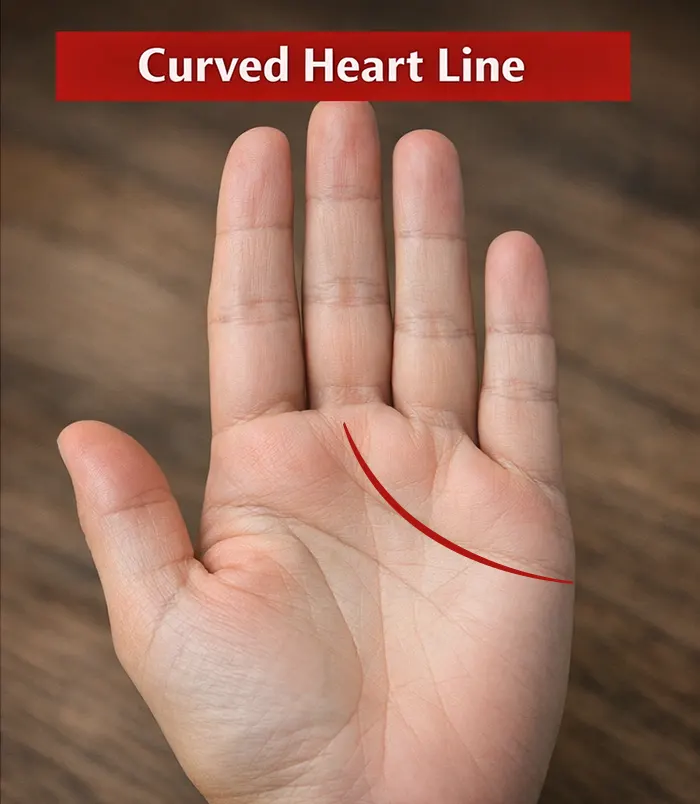
Core curved heart line personality traits include:
- Empathy and Compassion: You feel others’ emotions deeply, making you a supportive friend or partner. This trait fosters strong communities but risks emotional burnout.
- Romantic Idealism: Love for you is poetic and intense. You’re drawn to soulmate connections, often inspiring others with your optimism.
- Creativity in Expression: Curved lines link to artistic souls who communicate feelings through words, art, or actions.
Uniquely, link this to “anxious-secure” attachment styles, where passion fuels growth. To add value, practice mindfulness techniques like meditation to channel your intensity positively. Imagine using your curved line’s energy in modern dating: apps like Bumble could highlight your profile with heartfelt bios.
Variations: A deeply curved line might suggest overwhelming passion, while one curving downward could indicate melancholy. Branches or islands add layers, like multiple loves or emotional hurdles.
Straight vs Curved Heart Line: A Side-by-Side Comparison and Unique Insights
Comparing straight vs curved heart line personality traits reveals a spectrum of emotional styles. Straight lines favor logic and reserve, ideal for structured environments, while curved ones embrace flow and passion, thriving in dynamic settings. Neither is “better”—balance is key.
| Aspect | Straight Heart Line | Curved Heart Line |
|---|---|---|
| Emotional Approach | Analytical, controlled | Intuitive, expressive |
| Relationship Style | Stable, long-term focus | Passionate, adventurous |
| Strengths | Reliability, independence | Empathy, creativity |
| Challenges | Perceived detachment | Emotional overload |
| Career Fit | Analytical fields (e.g., tech, law) | Creative roles (e.g., arts, therapy) |
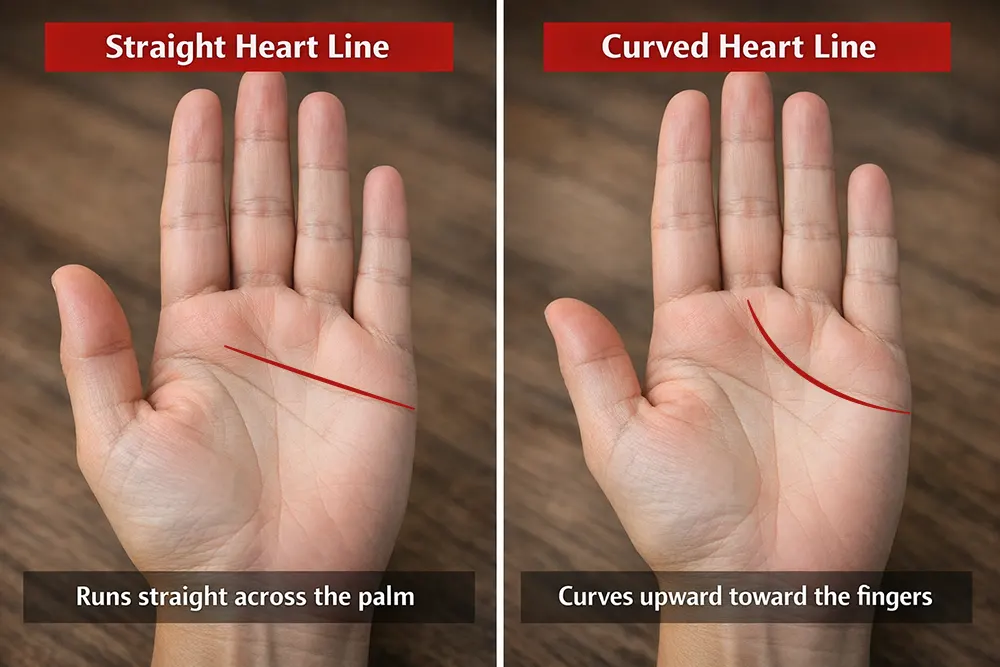
Uniquely, consider cultural contexts: In Eastern palmistry, curved lines align with yin energy (feminine, receptive), straight with yang (masculine, assertive). In today’s world, a straight line might excel in corporate negotiations, while curved thrives in social media influence. For value, blend traits—straight-lined folks can learn expressiveness through therapy, curved through planning tools.
How Heart Line Palmistry Influences Modern Life: Career, Relationships, and Mental Health
Beyond basics, heart line in palmistry offers practical applications. In careers, straight lines suit leadership where emotions are secondary, like CEOs or surgeons. Curved lines shine in people-oriented jobs, fostering team harmony.
In relationships, understanding your line helps compatibility. A straight-curved pair can balance logic and passion, creating resilient bonds. Use this for dating: Share palm readings as icebreakers.
For mental health, straight lines might suppress feelings, risking anxiety; curved could lead to empathy fatigue. Tips: Journal for straights, boundaries for curveds.
Unique idea: Integrate with personality tests like Myers-Briggs—straight often INTJ, curved ENFP.
Common Variations in Heart Line Palmistry and Their Meanings
No heart line is identical. Chained lines suggest fluctuating emotions; broken indicate transformations. Forked ends mean multifaceted love; islands signal obstacles.
In depth: A straight line with upward branches adds warmth; curved with downward dips warns of idealism pitfalls.
Frequently Asked Questions About Heart Line Palmistry
Here are common queries to demystify heart line palmistry:
- What does a straight heart line mean in love? It suggests practical, loyal partnerships but may need effort in romance.
- How do curved heart line personality traits affect friendships? They foster deep, empathetic bonds but require self-care.
- Can heart lines change over time? Yes, subtly with life experiences, reflecting growth.
- What’s the difference in heart line in hand between left and right? Left shows potential, right current state.
- Is palm reading heart line scientifically valid? While not proven, it correlates with genetic patterns.
- How to improve if my heart line indicates challenges? Self-reflection and therapy can help.
- Does heart line palmistry predict marriage? It hints at tendencies, not specifics.
- What if my heart line is faint? It may indicate sensitivity; strengthen through emotional exercises.
- Are there gender differences in heart lines? No, traits are universal.
- How accurate is straight vs curved analysis? It’s interpretive, best combined with full palm reading.
Conclusion: Embracing Your Heart Line for a Fulfilling Life
In wrapping up our exploration of straight vs curved heart line personality traits, remember that heart line palmistry is a tool for empowerment, not destiny. Whether your line is straight, offering grounded wisdom, or curved, brimming with passion, it invites self-reflection. By understanding these traits, you can build stronger relationships, choose aligned careers, and nurture mental well-being. Palmistry teaches us that our hands hold stories of resilience and growth—embrace yours, and let it guide you toward a more authentic life. If this resonates, try reading a friend’s palm and share your discoveries. The journey of the heart is endless, and yours is uniquely beautiful.
Related Posts
The Influence of Mounts on Life Line Strength in Palmistry: Unlocking Your Vitality Blueprint
Sun Line and Wealth: How Your Palm’s Apollo Line Reveals Financial Creativity
Life Line Ending in a Fork: Paths to Longevity
Partial Sun Line in Palmistry: Emerging Talent and Recognition
Famous Personalities with Strong Fate Lines
Faint Fate Line in Palmistry: What It Reveals About Gradual Career Development and Your Destiny