
Have you ever looked up at the night sky and wondered why certain moments in life feel destined, while others surprise you completely? Your birth chart holds the answer. Also known as a natal chart, a birth chart is a precise snapshot of the planets’ positions at the exact moment and location of your birth. It serves as your personal cosmic blueprint—a map that reveals your innate strengths, hidden challenges, emotional patterns, and life’s potential paths.
Unlike a daily horoscope that offers broad advice based solely on your sun sign, your birth chart dives much deeper. It weaves together the unique interplay of planets, zodiac signs, houses, and aspects to paint a full picture of who you are at soul level. In a world that often feels chaotic and uncertain, understanding your birth chart provides clarity, empowerment, and a sense of alignment with the universe itself. It’s not about fate dictating your every move; it’s about unlocking the secrets that help you navigate life with greater awareness and purpose.
This comprehensive guide introduces everything you need to know about what a birth chart truly is. Whether you’re completely new to astrology or ready to move beyond sun-sign basics, you’ll discover how this ancient tool remains profoundly relevant today. By the end, you’ll see your birth chart not as mystical entertainment, but as a practical guide for self-discovery, better relationships, career fulfillment, and personal growth.
The Ancient Origins of the Birth Chart: From Star Gazers to Modern Mastery
The concept of the birth chart stretches back thousands of years. Ancient Babylonians, Egyptians, and Greeks meticulously tracked planetary movements and linked them to human events. They viewed the heavens as a divine language—one that spoke directly to individual lives. By the Hellenistic period, astrologers had refined the system into the houses, signs, and aspects we still use today.
What makes the birth chart timeless is its foundation in observable astronomy combined with symbolic interpretation. The positions of the Sun, Moon, and planets at your birth reflect the energetic “weather” of that precise moment. Over centuries, astrologers evolved this into a psychological and spiritual framework. Modern practitioners blend traditional techniques with insights from psychology, making the birth chart a powerful tool for self-awareness rather than rigid prediction.
Today, millions turn to their birth chart for guidance because it offers something horoscopes alone cannot: personalization. Your birth chart captures the exact sky at your birth, making it as unique as your fingerprint. No two charts are identical—even twins born minutes apart have subtle differences that shift their rising signs or house placements.
Breaking Down the Core Elements of Your Birth Chart
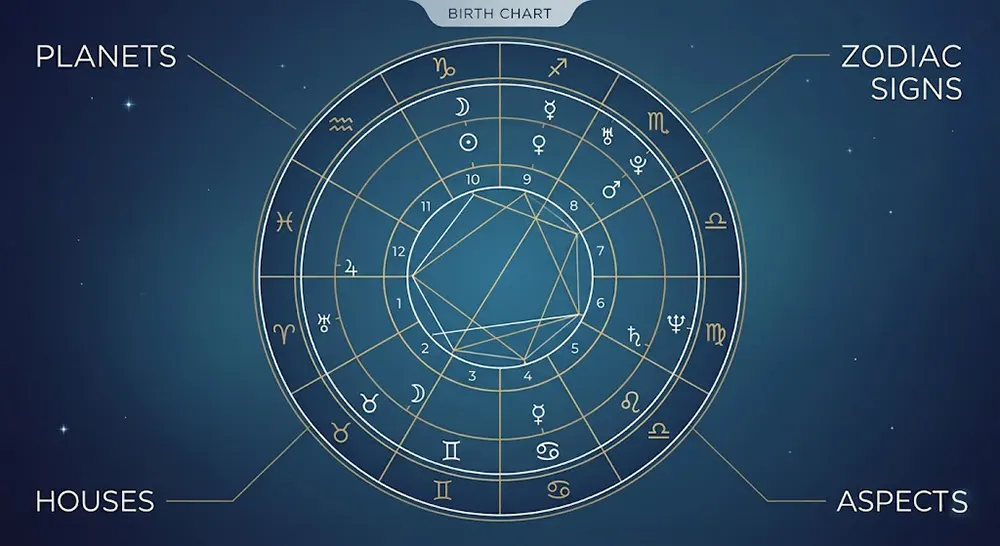
A birth chart looks like a circular wheel divided into twelve segments. At its center sits Earth, with the planets placed around the zodiac wheel according to their positions on your birth date, time, and place. Four key building blocks create its magic: planets, signs, houses, and aspects.
Planets represent different facets of your personality and life experiences. They act as the “actors” in your cosmic story. Signs show how those planets express themselves—the style or flavor of energy. Houses indicate where that energy plays out in your everyday life. Aspects reveal the relationships between planets—harmonious connections or challenging tensions that shape your growth.
Together, these elements form a dynamic system. Your birth chart doesn’t just describe you; it illuminates how you can work with your natural energies instead of against them.
The Big Three: Sun, Moon, and Rising—The Foundation of Your Identity
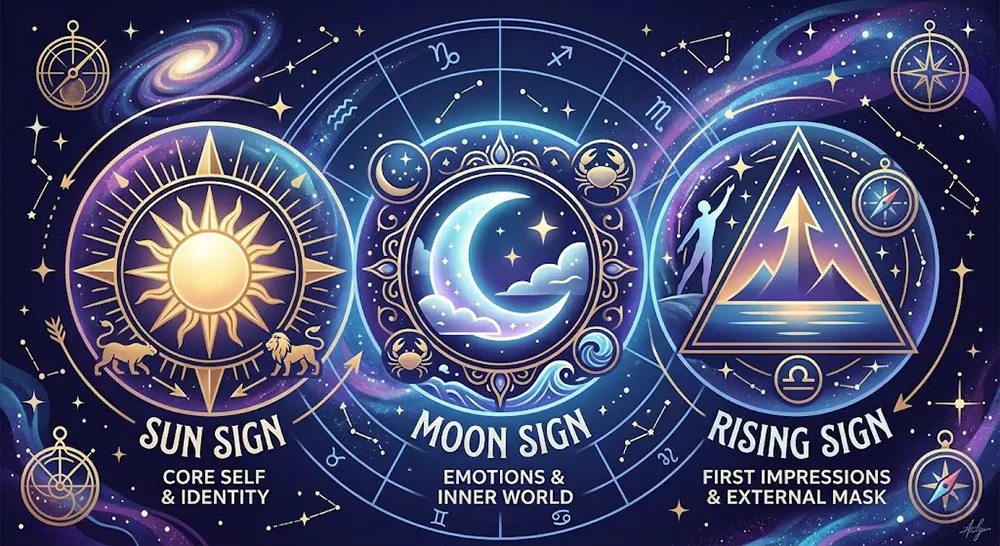
When people first explore their birth chart, they usually start with the Big Three. These three placements capture about 80 percent of your core personality and set the tone for deeper analysis.
Your Sun sign represents your essential self—your ego, vitality, and the main lessons you came here to learn. It’s the conscious “you” that shines brightest. For example, a Leo Sun might radiate creativity and leadership, while a Pisces Sun brings compassion and intuition.
Your Moon sign reveals your emotional world, instincts, and inner needs. It governs how you process feelings and what makes you feel secure. A Moon in Cancer craves nurturing and deep emotional bonds, whereas a Moon in Aquarius values independence and intellectual connection.
Your Rising sign (or Ascendant) is the mask you wear when meeting the world. It influences your physical appearance, first impressions, and overall life approach. Calculated from your exact birth time, it changes every two hours, which is why precise timing matters so much in a birth chart.
These three alone can transform how you see yourself. Many people feel an instant “aha” moment when they read their full Big Three description—it finally explains why they never quite fit their sun-sign stereotype.
The Planets: Cosmic Messengers in Your Birth Chart
Each planet in your birth chart governs a specific area of life and moves at its own pace, creating layers of meaning:
- Mercury rules communication, thinking, and learning. Its sign and house show how your mind works and how you express ideas.
- Venus governs love, beauty, values, and pleasure. It reveals what you find attractive and how you give and receive affection.
- Mars drives action, passion, and assertiveness. It highlights your drive, anger style, and what motivates you.
- Jupiter expands opportunities, luck, and wisdom. Its placement points to areas of growth and abundance.
- Saturn teaches discipline, responsibility, and long-term mastery. Often called the “teacher planet,” it shows where you build lasting structure through challenges.
- Uranus, Neptune, and Pluto are generational planets that add unique twists to your birth chart. They reveal innovation, spirituality, and transformation on both personal and collective levels.
Don’t overlook the lunar nodes (North and South Node), which point to your soul’s evolutionary path—what you’re here to develop versus what feels familiar from past experiences. Many modern birth charts also include Chiron, the “wounded healer,” showing where you turn pain into profound wisdom.
The Twelve Houses: Where Life Happens in Your Birth Chart
The houses in your birth chart act like twelve rooms in a cosmic mansion. Each house rules a different department of life, colored by the sign on its cusp and any planets inside:
- 1st House: Self-image, physical body, and new beginnings (ruled by your Rising sign).
- 2nd House: Values, money, and self-worth.
- 3rd House: Communication, siblings, and short trips.
- 4th House: Home, family, and emotional roots.
- 5th House: Creativity, romance, and joy.
- 6th House: Work, health, and daily routines.
- 7th House: Partnerships and marriage.
- 8th House: Shared resources, intimacy, and transformation.
- 9th House: Philosophy, travel, and higher learning.
- 10th House: Career, reputation, and public life.
- 11th House: Friendships, communities, and future goals.
- 12th House: Spirituality, hidden matters, and the subconscious.
A planet in a house amplifies that life area. For instance, Venus in the 7th House often indicates harmonious partnerships, while Saturn in the 10th House suggests a serious, achievement-oriented career path that rewards patience.
Aspects: The Dynamic Conversations in Your Birth Chart
Aspects are the geometric angles between planets in your birth chart. They show how energies flow or clash:
- Conjunction (0°): Planets blend powerfully.
- Sextile (60°): Harmonious opportunity.
- Square (90°): Tension that drives growth.
- Trine (120°): Natural talent and ease.
- Opposition (180°): Balance through awareness of opposites.
These relationships create the unique “dialogue” of your birth chart. A square between Mars and Saturn might indicate frustration around taking action, but it also builds incredible resilience over time.
Why Your Birth Chart Matters More Than Ever
In an age of endless information and rapid change, your birth chart offers something rare: a return to inner truth. It moves beyond surface-level personality tests to reveal your authentic wiring. Many people use their birth chart to:
- Improve relationships by understanding compatibility beyond sun signs.
- Make career decisions aligned with natural strengths.
- Navigate emotional patterns and break repeating cycles.
- Embrace timing—knowing when planetary transits activate certain areas of the chart.
Your birth chart doesn’t predict a fixed future. Instead, it shows potentials and invitations. Free will remains central. The more you understand your birth chart, the more intentionally you can respond to life’s opportunities and challenges.
How to Get and Start Reading Your Own Birth Chart
Obtaining your birth chart is simple and often free. You’ll need your exact birth date, time (as precise as possible), and birthplace. Many reputable online tools generate accurate charts instantly. Once you have it:
- Identify your Big Three.
- Note dominant elements (fire, earth, air, water) and modalities (cardinal, fixed, mutable) for overall temperament.
- Look for stelliums—three or more planets in one sign or house—for concentrated energy.
- Read planet-by-planet, house-by-house.
- Consider aspects for the full story.
Start simple. Journal your observations. Over time, patterns will emerge that feel eerily accurate. Many beginners keep a birth chart notebook, revisiting it during major life transitions for fresh insights.
Common Myths About Birth Charts—Busted
Myth 1: “Your birth chart seals your destiny.” Truth: It reveals tendencies and potentials, not a predetermined script.
Myth 2: “Only your sun sign matters.” Truth: The full birth chart provides the complete picture.
Myth 3: “Astrology is just entertainment.” Truth: Serious study of the birth chart has helped countless people achieve deeper self-understanding and meaningful change.
Frequently Asked Questions About Birth Charts
What is the difference between a birth chart and a natal chart? They are the same thing. “Natal” comes from the Latin word for birth.
Do I need my exact birth time for an accurate birth chart? Yes—especially for the Rising sign and house placements. Without it, you can still get valuable planetary sign information, but the chart remains incomplete.
Can birth charts predict the future? They show energetic windows and themes through transits (current planetary movements compared to your natal positions). Prediction is more about probability and awareness than certainty.
How accurate are online birth chart calculators? High-quality free tools using standard astronomical data are very reliable when you input correct information.
What if I don’t relate to parts of my birth chart? Astrology reflects potentials, not absolutes. Environmental factors, free will, and personal growth all influence how energies manifest. Revisit your chart in a few years—you may see new layers.
Can two people have the same birth chart? Extremely rare. Even twins usually have slight differences due to birth timing.
How does a birth chart help with relationships? Comparing charts (synastry) reveals natural harmonies and growth areas between people.
Is astrology scientific? While rooted in astronomy, astrology is symbolic and interpretive. Its value lies in the meaningful insights it provides rather than empirical proof.
Should I focus only on challenging placements in my birth chart? No. Celebrate strengths while working consciously with any tensions. Every placement offers gifts.
How often should I look at my birth chart? Regularly during major life decisions or planetary transits that activate your chart. Many people check it monthly or yearly for perspective.
Embracing Your Cosmic Blueprint: A Final Reflection
Your birth chart is far more than lines and symbols on a wheel. It is a loving message from the universe, delivered at the moment you took your first breath. It reminds you that you are part of something vast yet intimately connected to your own unique journey.
In unlocking the secrets of your birth chart, you step into greater authenticity. You stop comparing yourself to others and start honoring your individual rhythm. You learn to flow with challenges instead of fighting them. Most importantly, you discover that the cosmos isn’t “out there”—it lives within you, guiding you toward your highest potential.
Whether you’re seeking clarity in love, purpose in work, or peace in your inner world, your birth chart offers a reliable companion. It doesn’t promise an easy path, but it illuminates the one that is truly yours. The stars don’t control you—they reflect you. And in that reflection lies incredible power.
Take a moment today to pull up your birth chart. Look at it with fresh eyes and an open heart. What secrets will it reveal? What strengths will it affirm? What adventures will it invite?
The cosmos has been waiting to speak with you since the day you were born. Your birth chart is the conversation starter. Are you ready to listen—and to live the beautiful, complex, extraordinary story written in the stars just for you?
Your journey with your birth chart is only beginning. May it bring you insight, compassion, and the deep joy of knowing yourself more fully than ever before. The universe is on your side—and now, so is your cosmic map.
Related Posts
Sun in Your Birth Chart: The Core of Your Identity
How to Read Your Birth Chart: A Beginner’s Guide