
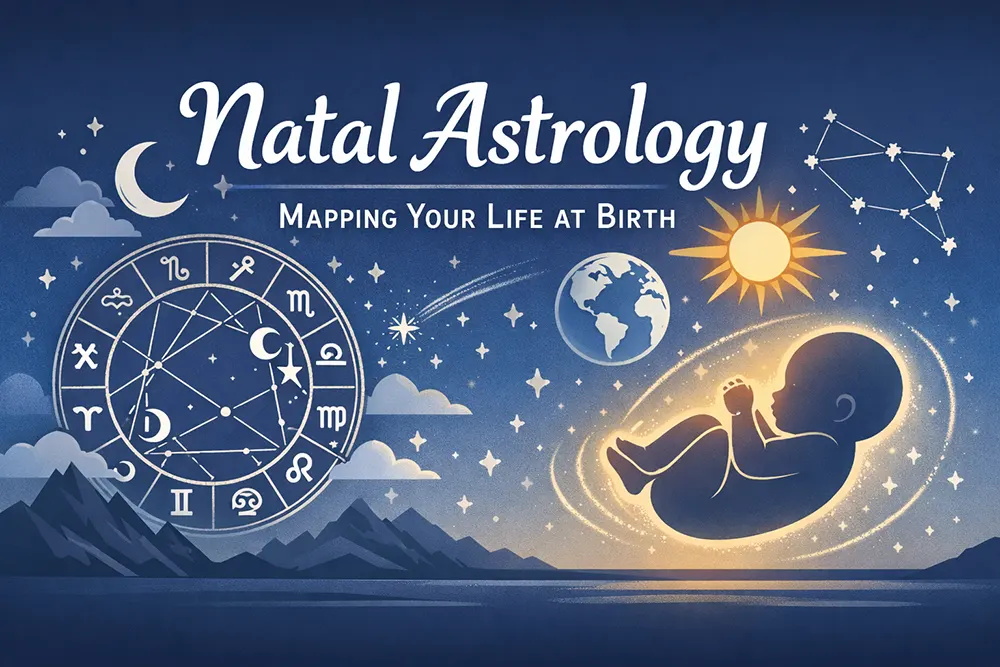
In the vast realm of natal astrology, your birth chart serves as a personalized cosmic blueprint, capturing the exact positions of the planets, stars, and celestial bodies at the moment of your birth. This intricate map, often referred to as a natal chart or astrology birth chart, offers profound insights into your personality, life path, relationships, career potential, and even spiritual growth. Whether you’re a newcomer curious about how to read a birth chart or a seasoned enthusiast seeking deeper birth chart interpretation, understanding natal astrology can empower you to navigate life’s challenges and opportunities with greater clarity and confidence.
As a palmist and astrologer, I’ve spent years blending the ancient arts of chiromancy (palm reading) and natal astrology to help individuals uncover hidden truths about themselves. In this comprehensive guide, we’ll dive deep into the world of birth charts, exploring their components, history, practical applications, and unique ways to integrate them with other divinatory practices. By the end, you’ll have the tools to embark on your own journey of self-discovery through natal astrology.
What Is Natal Astrology and Why Does Your Birth Chart Matter?
Natal astrology, at its core, is the branch of astrology that focuses on the positions of celestial bodies at the precise time, date, and location of your birth. Unlike general horoscopes that lump everyone under broad zodiac signs, a birth chart provides a tailored snapshot of the heavens, revealing how planetary energies influence your unique life story. The term “natal” derives from the Latin word for birth, emphasizing this personal, moment-specific approach.
Your birth chart isn’t just a random assortment of symbols—it’s a dynamic tool for birth chart interpretation that can highlight strengths, weaknesses, and potential life themes. For instance, while your Sun sign might indicate your core identity, the full birth chart weaves in the Moon’s emotional depth, Mercury’s communication style, and Saturn’s lessons in discipline. In today’s fast-paced world, where self-awareness is key to personal and professional success, mastering how to read a birth chart can lead to better decision-making, improved relationships, and a stronger sense of purpose.
Consider this: Studies in psychology and behavioral science often explore personality traits through frameworks like the Big Five, but natal astrology offers an ancient, holistic alternative that’s been refined over millennia. By aligning your birth chart with modern life coaching techniques, you can create actionable plans for growth. This guide will equip you with the knowledge to do just that, ensuring every insight is grounded in real value and practical application.
The Rich History of Natal Astrology: From Ancient Roots to Modern Practice
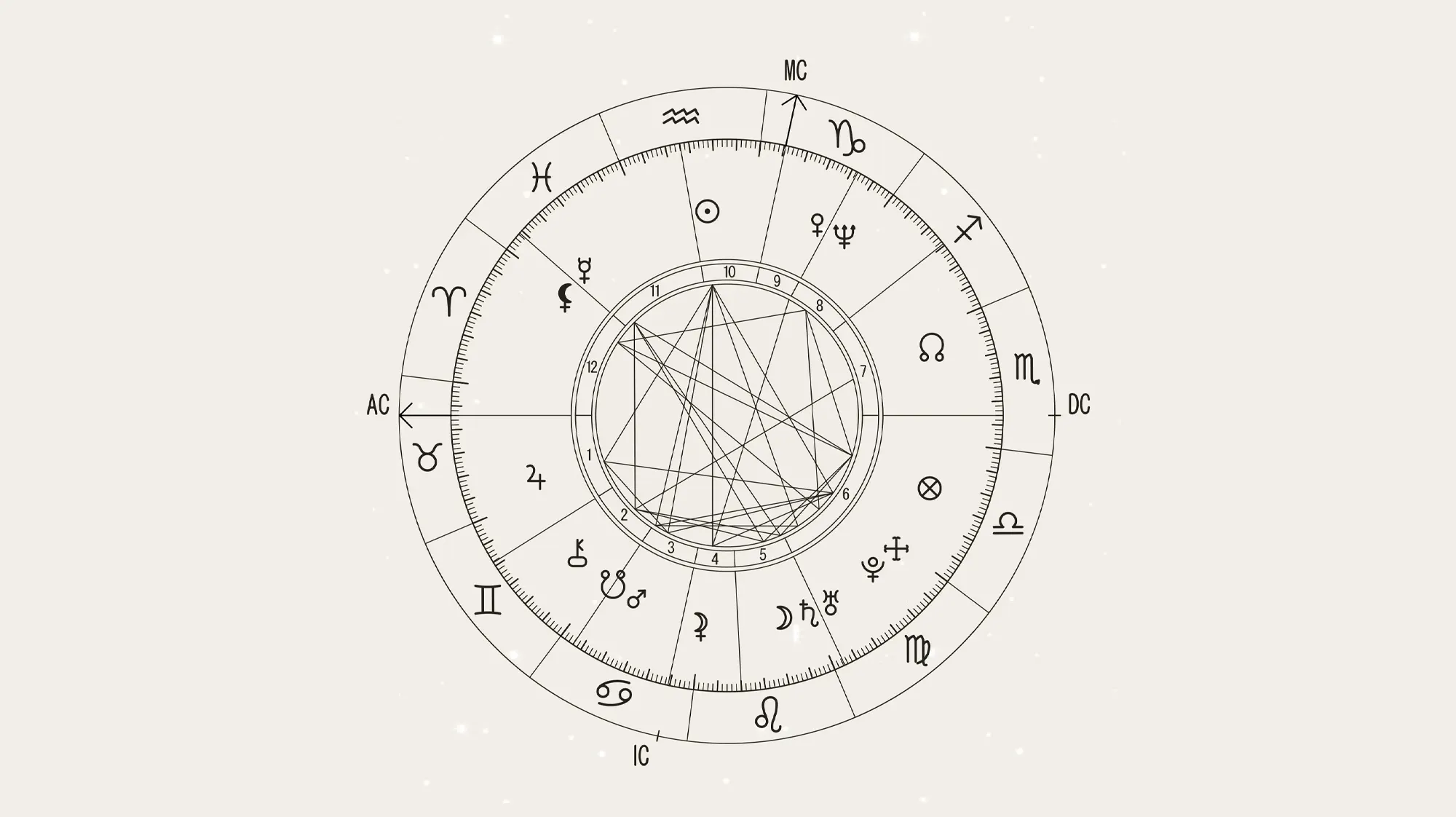
Natal astrology’s origins trace back to ancient civilizations, where early astronomers and mystics observed the skies to predict human fates. The Babylonians, around 2000 BCE, laid the groundwork by dividing the ecliptic into 12 zodiac signs, a system that evolved into the birth charts we use today. By the time of the Hellenistic period in Greece (circa 300 BCE), figures like Ptolemy formalized natal astrology in his seminal work, Tetrabiblos, which emphasized the birth chart as a map of one’s destiny.
In ancient Egypt, natal astrology intertwined with religious practices, where pharaohs consulted birth charts for guidance on rulership and warfare. The Romans adopted and adapted these ideas, with emperors like Augustus commissioning detailed natal charts to legitimize their power. Fast-forward to the Islamic Golden Age (8th-13th centuries), scholars like Al-Biruni advanced birth chart interpretation by incorporating mathematical precision and astronomical observations.
The Renaissance brought a resurgence in Europe, with astrologers like Nostradamus blending natal astrology with prophecy. However, the Enlightenment’s emphasis on science pushed it to the fringes until the 20th century, when psychologists like Carl Jung explored archetypes in birth charts as reflections of the collective unconscious. Today, natal astrology thrives in a digital age, with apps and online tools making birth chart access instantaneous.
What sets modern natal astrology apart is its integration with other fields. As a palmist, I often compare the lines on one’s hand—such as the fate line—with planetary placements in the birth chart. For example, a strong Saturn in the birth chart might correlate with a prominent head line in palmistry, indicating discipline and intellect. This unique fusion adds layers of depth, offering clients a multifaceted view of their potential.
Despite its ancient roots, natal astrology remains relevant because it adapts. In an era of uncertainty, understanding your birth chart can provide a sense of control and foresight, much like how businesses use data analytics for strategic planning.
Breaking Down the Key Components of Your Birth Chart
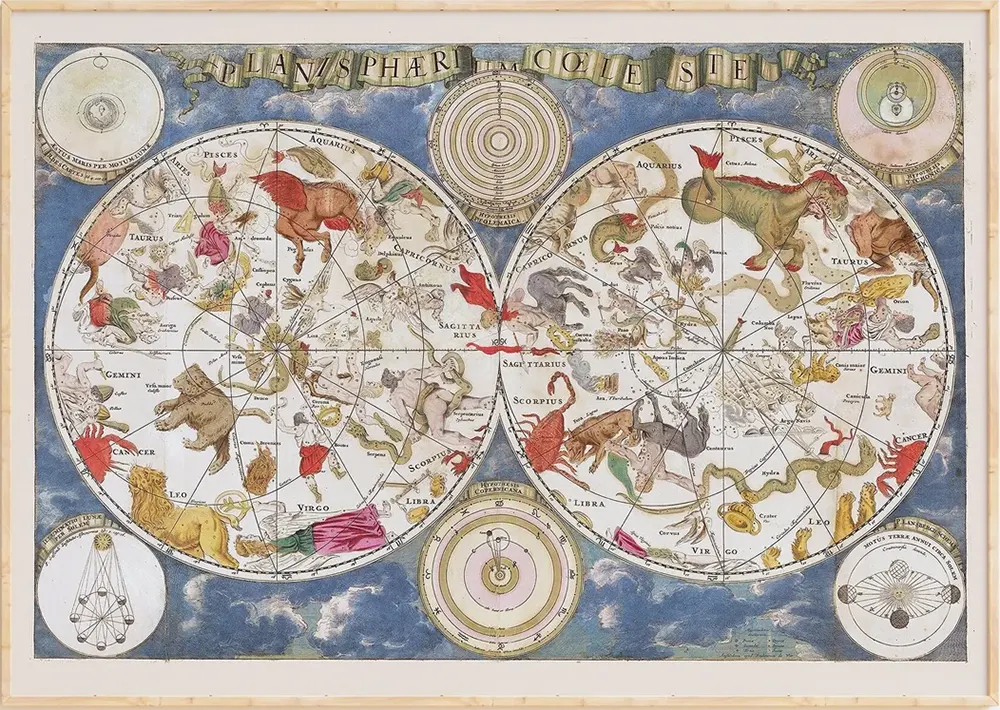
To truly grasp how to read a birth chart, you must understand its building blocks. A birth chart is typically presented as a circular wheel, divided into 12 sections representing the zodiac signs and houses. At the center lies the Earth (your birthplace), with planets positioned around it based on their locations at birth.
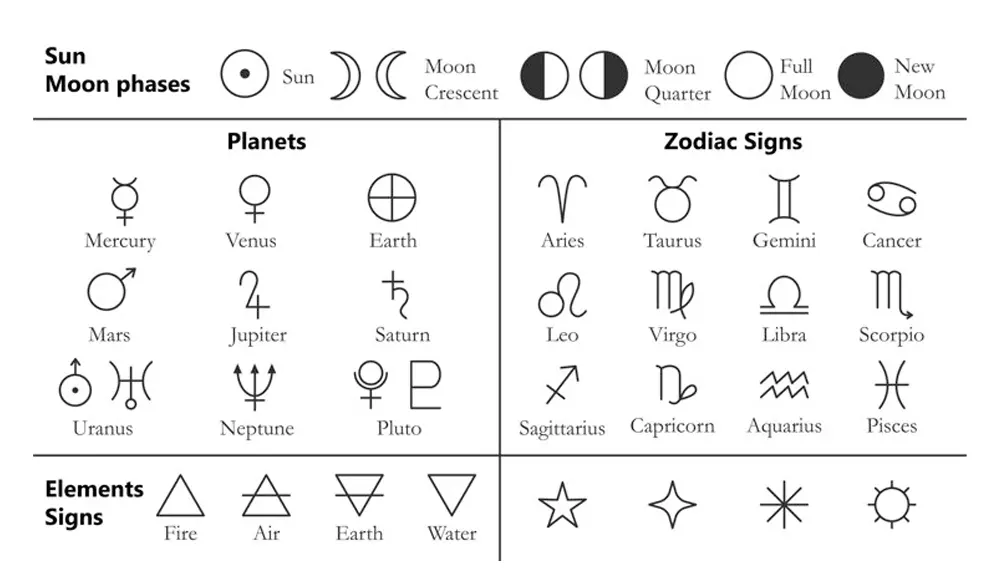
The Zodiac Signs: Your Cosmic Personality Palette
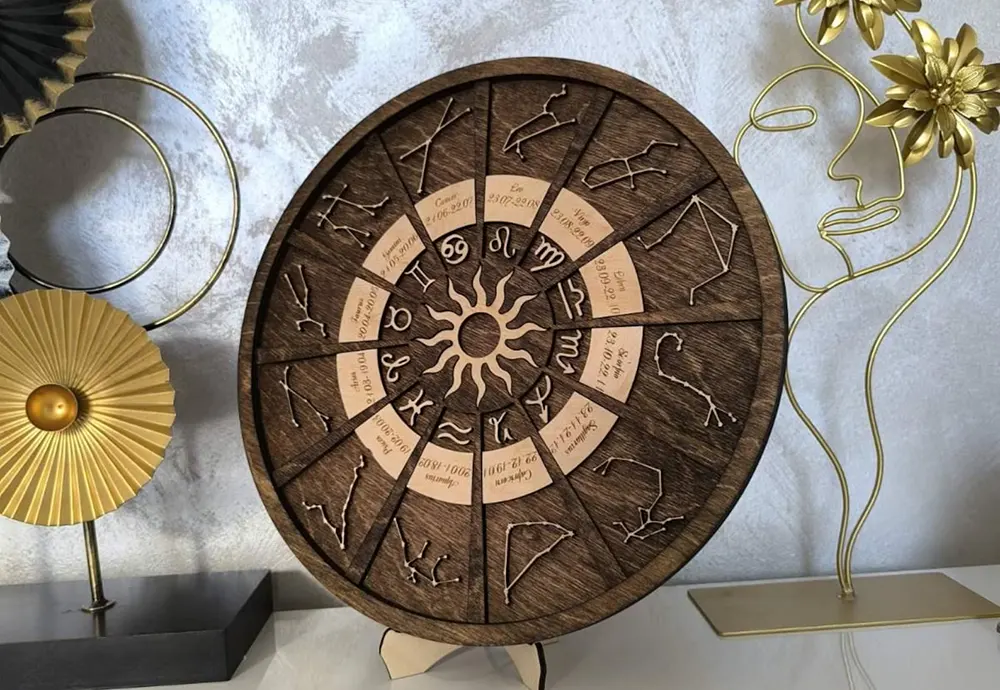
The 12 zodiac signs form the foundation of your birth chart, each imparting specific energies to the planets they host. Aries ignites action and leadership, while Taurus grounds us in stability and sensuality. Gemini fosters curiosity and communication, Cancer nurtures emotional depth, Leo radiates creativity and confidence, Virgo emphasizes precision and service, Libra seeks harmony and partnerships, Scorpio delves into transformation and intensity, Sagittarius explores adventure and philosophy, Capricorn builds ambition and structure, Aquarius innovates with humanitarian ideals, and Pisces dreams in empathy and intuition.
In natal astrology, signs modify planetary expressions. For birth chart interpretation, note where your Sun, Moon, and Rising signs fall—these form your “Big Three.” A unique idea: Pair your dominant zodiac sign with palmistry’s mount of Venus (for love) or Jupiter (for luck) to reveal hidden talents.
The Planets: Celestial Messengers in Your Natal Chart
Planets in natal astrology symbolize different facets of your psyche and life experiences. The Sun represents your ego and vitality, the Moon your emotions and instincts, Mercury your mind and communication, Venus your values and relationships, Mars your drive and assertiveness, Jupiter your expansion and luck, Saturn your discipline and challenges, Uranus your innovation and rebellion, Neptune your dreams and illusions, and Pluto your transformation and power.
Outer planets like Uranus, Neptune, and Pluto influence generations, while personal planets (Sun through Mars) are more individualistic. In birth chart interpretation, planetary positions reveal life themes—for example, a Venus in Libra might indicate a natural diplomat.
As an astrologer and palmist, I often see correlations: A prominent Mars in the birth chart aligns with a strong Mars line in the palm, signaling high energy levels.
The Houses: Life Areas Illuminated by Your Birth Chart
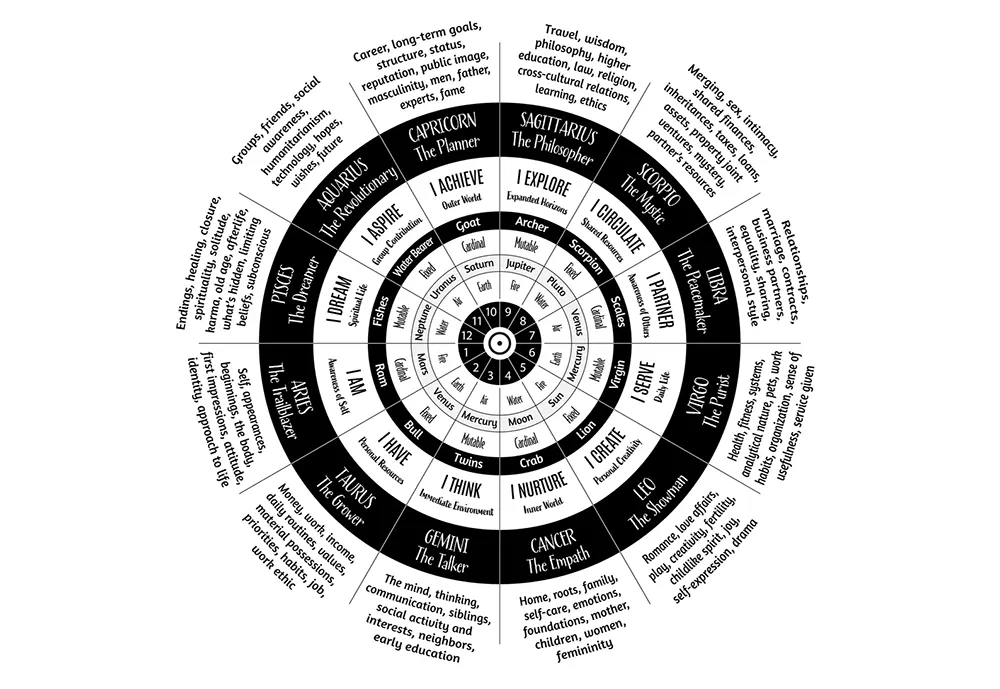
The 12 houses in a birth chart represent different life domains, from self-identity (1st House) to career (10th House). The Ascendant (Rising sign) marks the cusp of the 1st House, setting the tone for the entire chart. Houses add context: A Sun in the 7th House might emphasize partnerships in your life path.
Unique twist: Integrate house energies with palmistry’s quadrants—the lower palm for instincts mirrors the lower houses in natal astrology.
Aspects: The Dynamic Interactions in Natal Astrology
Aspects are angles between planets, indicating harmony or tension. Conjunctions blend energies, squares create challenges, trines offer ease, oppositions demand balance, and sextiles provide opportunities. In birth chart interpretation, aspects like a Sun-Moon trine suggest emotional harmony.
Innovative idea: View aspects as “conversations” between palm lines— a square aspect might mirror crossed lines, indicating growth through adversity.
How to Generate and Begin Reading Your Birth Chart
Creating your birth chart is easier than ever with free online tools like Astro.com or apps like Co-Star. You’ll need your birth date, time (as precise as possible), and location. Once generated, start with the Big Three: Sun (essence), Moon (emotions), Rising (outer self).
For deeper birth chart interpretation, examine planetary signs, houses, and aspects. Practice by journaling how these elements manifest in your life. As a palmist, I recommend cross-referencing with a palm reading for validation—often, the heart line echoes Venus placements.
Applying Natal Astrology to Everyday Life
Personality and Self-Discovery Through Your Birth Chart
Your birth chart reveals innate traits: A dominant Fire element (Aries, Leo, Sagittarius) suggests passion, while Earth signs (Taurus, Virgo, Capricorn) indicate practicality. Use this for self-improvement, like leveraging a Mercury in Gemini for better communication.
Unique integration: Compare your birth chart’s elemental balance with palmistry’s finger shapes—phalanx lengths can mirror planetary strengths.
Career Guidance from Natal Astrology
The 10th House and Midheaven in your birth chart point to vocational paths. A Capricorn Midheaven might suit leadership roles. Combine with Jupiter’s placement for growth areas.
In my practice, I’ve seen clients align career shifts with transits, confirmed by palmistry’s fate line changes.
Relationships and Compatibility in Birth Charts
Synastry compares birth charts for compatibility. Venus-Mars aspects indicate attraction. For lasting bonds, look at Moon placements for emotional sync.
Blend with palmistry: Marriage lines on the palm can correlate with 7th House energies.
Health and Wellness Insights
While not medical advice, natal astrology highlights vulnerabilities—Saturn in the 6th House might suggest chronic issues. Use for holistic wellness planning.
Spiritual Growth and Life Purpose
North Node in the birth chart reveals karmic lessons. As an astrologer-palmist, I see it aligning with the life line’s direction.
Unique Ideas: Blending Natal Astrology with Palmistry
One distinctive approach is merging natal astrology with chiromancy. For example, the mount of Mercury in the palm reflects communication, echoing Mercury’s birth chart position. This hybrid method offers clients a tangible, hands-on validation of celestial insights, making abstract concepts more relatable.
Imagine a session where we map your birth chart’s Venus onto your palm’s heart line, revealing love patterns with unprecedented accuracy. This innovation bridges ancient traditions, providing real-value tools for personal empowerment.
Common Misconceptions About Birth Charts Debunked
Myth: Birth charts predict exact events. Reality: They suggest potentials, not certainties.
Myth: Astrology is pseudoscience. Reality: It’s a symbolic language for self-reflection, supported by historical and cultural significance.
Frequently Asked Questions (FAQs) About Natal Astrology and Birth Charts
What is a birth chart in natal astrology?
A birth chart, or natal chart, is a map of planetary positions at your birth, used for personality and life insights.
How accurate is birth chart interpretation?
Accuracy depends on birth time precision and interpreter expertise, but it’s a tool for guidance, not absolutes.
Can I read my own birth chart without experience?
Yes, start with basics like Sun, Moon, Rising. Resources abound online.
What’s the difference between a birth chart and a horoscope?
Horoscopes are general; birth charts are personalized.
How does natal astrology differ from other types?
It focuses on birth moment, unlike predictive (transits) or relational (synastry) astrology.
Do I need my exact birth time for a birth chart?
Ideal, but approximations work; it affects house placements most.
Can birth charts change over time?
No, but transits interact with it, showing evolution.
Is natal astrology compatible with science?
It’s metaphorical, complementing psychology for self-awareness.
How can I use my birth chart for career decisions?
Look at 10th House, Midheaven, and Saturn for structure.
What if my birth chart shows challenging aspects?
They indicate growth areas; embrace them for transformation.
Conclusion: Embrace Your Cosmic Map for a Fulfilling Life
In conclusion, your birth chart in natal astrology is more than a diagram—it’s a lifelong companion for mapping your journey. By understanding its components and applying them thoughtfully, you unlock doors to self-knowledge, resilience, and joy. As a palmist and astrologer, I encourage you to explore this with an open heart, perhaps blending it with other practices for even richer insights. Remember, the stars don’t dictate; they illuminate. Step into your power, interpret your birth chart wisely, and let it guide you toward a meaningful existence.

Uranus energy sparks awakening.
Absolutely! Uranus energy is often associated with awakening, breakthroughs, and sudden shifts in perspective. In a birth chart, its placement can reveal where innovation and transformation are most likely to occur. Thank you for sharing your insight!
I am blown away by the depth and detail in your posts Keep up the excellent work and thank you for sharing your knowledge with us
Thank you so much! We’re glad you’re finding the content insightful and valuable.
Of course, what a magnificent site and illuminating posts, I surely will bookmark your blog.Have an awsome day!
Thank you so much! We appreciate your support and hope to see you again soon.